















President Donald Trump was “close” to firing Commerce Secretary Howard Lutnick after Lutnick acknowledged visiting Jeffrey Epstein’s private island, then “stopped talking about replacing Lutnick” after the commerce secretary made a $25 million donation to Trump’s presidential library, The Wall Street Journal reported late Saturday. The account was described Sunday by Mediaite.
Lutnick, a billionaire and former chairman of Cantor Fitzgerald, had been “very much on the chopping block” over the Epstein visit, the Journal reported. After the library donation, the paper said, Trump stopped talking about replacing him. The sequence is the Journal’s reporting, based on its sources. It does not, on its own, prove that the donation was a formal bargain. It does place a large gift to the president’s library next to a sudden change in how the president talked about the secretary’s job.
Lutnick has also been under fire from Treasury Secretary Scott Bessent over Megaspeed, a Singapore-based data center company at the center of the ongoing Nvidia controversy. Bessent has repeatedly blamed the Commerce Department for failing to place Megaspeed on a blacklist of companies that pose a national security threat. Two Republican senators have joined the criticism. Sen. Tom Cotton of Arkansas has said Lutnick “repeatedly ignored warnings” that U.S. AI chips were being smuggled to China. Sen. Thom Tillis of North Carolina told the Journal that Lutnick “needs to be replaced with somebody who can perform better for the president.”
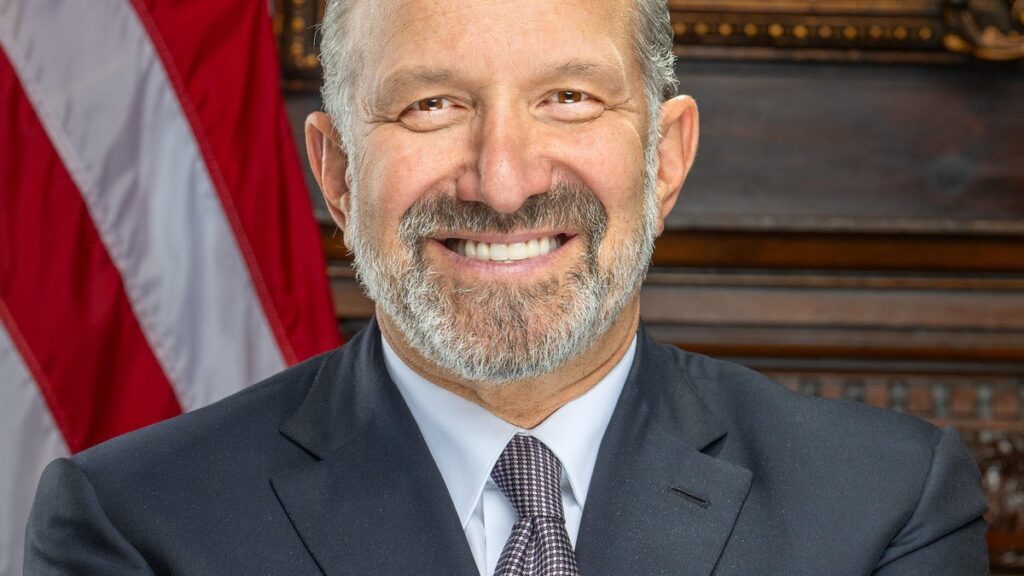
A vote of confidence, on camera
Against that backdrop, Trump gave Lutnick a public vote of confidence at Friday’s news conference, saying he believes the commerce secretary is doing a “very good job.” The White House told the Journal that Trump maintains complete confidence in him.
The Journal also reported that Lutnick was buoyed by the departure of Susie Wiles as White House chief of staff and that he has a good relationship with her successor, Stephen Miller. If accurate, that would help explain why a secretary who had been, in the paper’s telling, close to dismissal is still in the job after a week of brutal coverage. It would also mean Lutnick’s survival depends as much on the new West Wing alignment as on the president’s personal comfort.
Money, the island, and the job
The $25 million figure is large enough, and close enough to a personnel scare, that it will be read as a purchase of job security whether or not anyone can prove a quid pro quo. Presidential libraries are private foundations. They can accept huge gifts from people who do business with, or serve in, an administration. That is legal in a way that would be forbidden in a federal campaign account, and it is also why such gifts attract scrutiny when the donor’s standing in the administration is in doubt.
The Epstein issue is separate and, for Lutnick, more personal. Acknowledging a visit to the island put him in a category the president has been eager to police in public, even as the administration faces Democratic investigations of how it has handled the Epstein files. If the Journal is right that the visit is what put Lutnick “on the chopping block,” then the library gift is being asked to do a lot of political work: quiet a scandal, keep a commerce secretary, and move the conversation back to trade and chips.
It may not do all of that work. Bessent’s criticism, and the comments from Cotton and Tillis, are about export controls and China, not about a library. Those complaints will still be there on Monday. A president saying “very good job” on Friday, and a White House restating “complete confidence,” is how this administration signals that a firing has been taken off the table, at least for now. It is not the same thing as ending the underlying fights.
Readers should keep the sourcing in view. The most explosive piece (that Trump was close to firing Lutnick and then stopped talking about it after the donation) comes from the Journal’s unseen sources. The donation itself, the public “very good job” comment, Bessent’s criticism, and the quotes from Cotton and Tillis are more checkable. Together they describe a commerce secretary who has been in real trouble and is, as of this weekend, still in office.
The Journal report was published late Saturday and described Sunday morning by Mediaite. The White House’s statement of confidence was given to the Journal.
Commerce is not a ceremonial department in this administration. It sits on export licenses, tariff implementation, and the statistical machinery of trade policy, which is why a fight with the Treasury secretary over a blacklist is not a sideshow. If Cotton is right that warnings about AI chips going to China were “repeatedly ignored,” then the personnel question is also a national security question. If he is not, then Lutnick is being used as a target in a broader Nvidia and China fight. The Journal story does not settle that. It only explains why the secretary’s job was already fragile before the library gift entered the picture.
Lutnick’s defenders will say a billionaire commerce secretary is entitled to give money to a presidential library, and that a president is entitled to keep a cabinet officer he now says is doing a very good job. Critics will say the proximity of the gift to a reported firing scare is the entire story. Both arguments will travel. The responsible way to write it is the way the Journal framed the sequence: Lutnick was in trouble over the Epstein visit, he wrote a very large check, and the president stopped talking about replacing him. What happened in between, in the president’s mind, is what the sources are inferring.
Until someone in the White House or the library foundation adds more on the record, that inference is the news, and it should stay labeled as reporting, not as a concluded contract.
One more practical detail is worth keeping in view. A $25 million gift to a presidential library is large even by the standards of those foundations, and it will invite questions about whether other cabinet officials or interested donors have made similar contributions, and about how the library discloses them. Those are good government questions, and they do not require anyone to prove a firing was called off because of the check. They only require the foundation, and the White House, to be clear about who is giving, how much, and when.